Fork from https://github.com/diorwave/cmd-chat
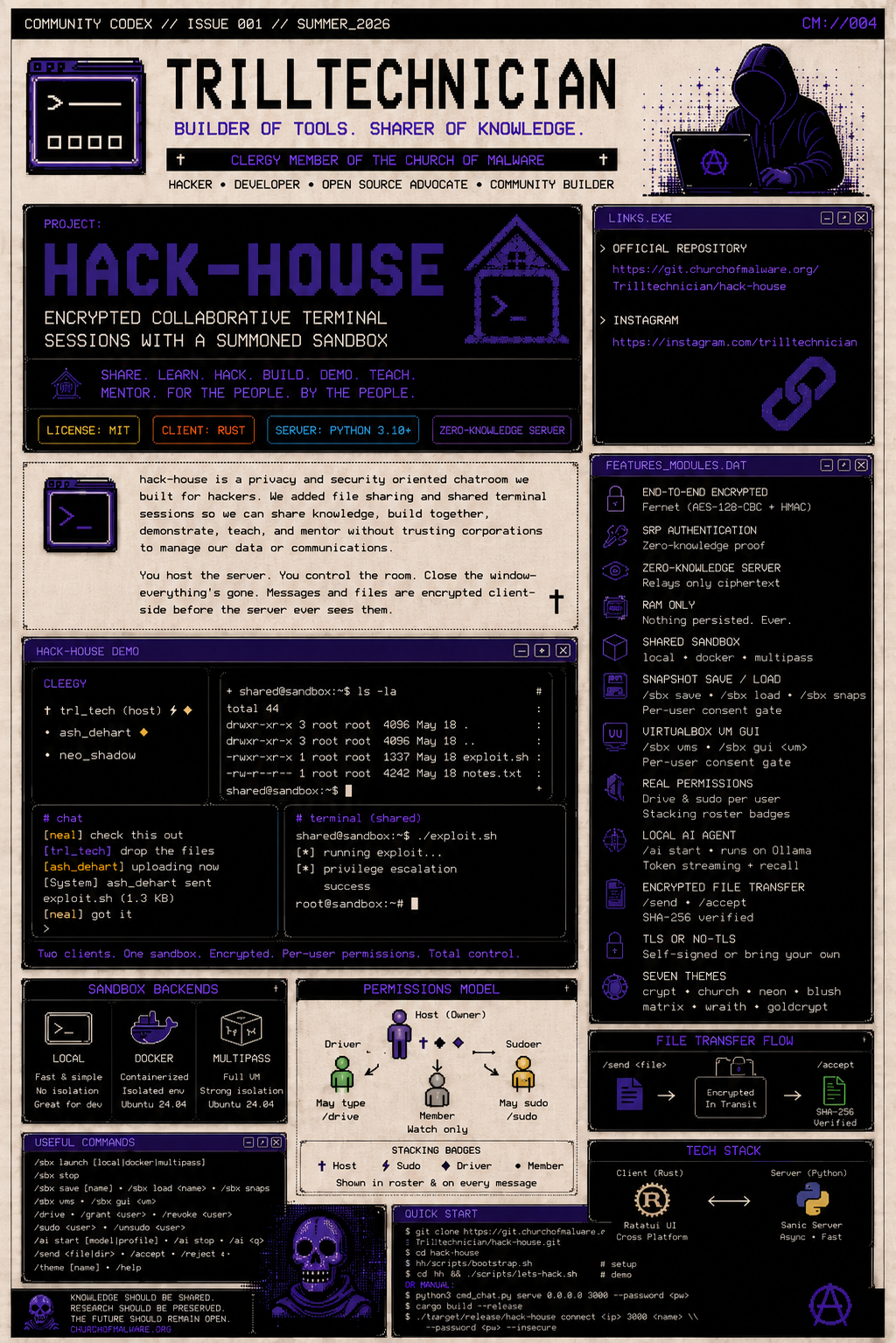
This tool a privacy and security oriented chatroom that we added file sharing as well as shared terminal sessions.
For sharing. For learnng. For hacking. For building. For demos. For teaching. For mentorhsip for the people who dont want to trust corporations to manage their data and communications.
Encrypted chat that runs in your terminal. You host the server, you control the room. Close the window — everything's gone. Messages and files are encrypted client-side before the server ever sees them.
Features
- End-to-end encrypted — Fernet (AES-128-CBC + HMAC), encrypted client-side before anything leaves your machine
- SRP authentication — the password is never sent over the network (zero-knowledge proof)
- Zero-knowledge server — relays only ciphertext; cannot read messages, files, or terminal output
- RAM only — nothing persisted on the server; close it and history is gone
- Shared sandbox — summon a disposable
local/docker/podman/multipassbox the whole room can watch and drive. Docker defaults to Parrot OS Security (parrotsec/core) and Podman to Kali (kalilinux/kali-rolling) — pentest distros out of the box; Podman is rootless & daemonless, so no sudo to launch - Snapshot save/load — freeze a sandbox to a named snapshot and restore it later (
/sbx save·/sbx load·/sbx snaps) - Local VirtualBox VMs —
/sbx vmsdetects VirtualBox and lists your VMs;/sbx gui <vm>opens a desktop VM locally for the room to gather around — per-user consent gate, with automatic resolution of VT-x conflicts (Docker Desktop / multipass) - Real permissions — the host grants/revokes drive (keyboard) and sudo (VM superuser) per user; stacking roster badges show exactly who holds what, both in the clergy panel and inline on every chat message
- Local-first AI agent —
/ai startsummons an in-room AI that runs against your own Ollama (no API key, nothing leaves your machine); replies stream token-by-token with in-RAM semantic recall of the conversation for context; model-agnostic, addressed-only, end-to-end encrypted like every other client - AI that acts in the sandbox — grant an agent drive and address it with
/ai <name> !<task>; it works the shared box through a bounded, host-side tool-calling loop (run shell, write/read files, inspecting each result before the next step) and you watch its commands land live in the shared terminal. Ungranted, it stays advisory-only (tells you the commands, runs nothing); destructive commands are gated behind an explicit/ai <name> confirm - Encrypted file transfer —
/send→/acceptwith SHA-256 verification - TLS — self-signed by default, or bring your own cert;
--no-tlsfor local/Tailscale use - Themes — seven switchable "vestments" (
cryptdefault ·church·neon·blush·matrix·wraith·goldcrypt), plus a live randomizer
Layout
| Path | What |
|---|---|
hh/ |
The Rust ratatui client (the flagship) |
cmd_chat/, cmd_chat.py |
The Python (Sanic) server + legacy Python client |
cmd_chat/agent/ |
The model-agnostic AI agent bridge (joins a room as an encrypted client) |
models.toml |
Named provider profiles for /ai start <profile> (see docs/providers.md) |
docs/providers.md |
Connect any model — profiles, flags, discovery, bring-your-own-provider |
hh/scripts/ |
Helper scripts — setup, hosting, sandbox provisioning, tests (see Scripts; each takes -h/--help) |
hh/direnv-autostart/ |
cd into a directory to auto-launch a session (direnv) |
Quick start
git clone https://git.churchofmalware.org/trilltechnician/hack-house.git
cd hack-house
1. One-shot setup (hh/scripts/bootstrap.sh)
Checks prerequisites, creates the Python venv, installs the server's
dependencies, and builds the Rust client:
hh/scripts/bootstrap.sh              # venv + deps + debug build
hh/scripts/bootstrap.sh --release    # release build
hh/scripts/bootstrap.sh --check      # report tooling only, change nothing
bootstrap.shdoes not touch direnv — the autostart in step 4 is a
separate, opt-in convenience.
Optional AI layer (hh/scripts/bootstrap-ai.sh). Want the local /ai agent? This runs
the baseline setup first, then installs Ollama (if missing) and pulls a default
model — nothing here changes the AI-free baseline above:
hh/scripts/bootstrap-ai.sh                      # baseline + Ollama + qwen2.5:3b
hh/scripts/bootstrap-ai.sh --check              # report only, change nothing
HH_AI_MODEL=llama3 hh/scripts/bootstrap-ai.sh   # pull a different model
2. Try it in tmux (scripts/lets-hack.sh)
The fastest way to see it working: builds the client, boots a fresh --no-tls
server on 127.0.0.1:4173, and opens a pane per user.
cd hh
./scripts/lets-hack.sh                  # alice + bob, tiled in tmux
./scripts/lets-hack.sh neo trinity      # custom users
./scripts/lets-hack.sh --theme neon     # pick vestments
./scripts/lets-hack.sh --reuse          # keep a live server (reconnect tests)
./scripts/lets-hack.sh --kill           # tear it all down
3. Manual setup
Server (Python):
pip install -r requirements.txt
python3 cmd_chat.py serve 0.0.0.0 3000 --password <room-password>
Client (Rust):
cd hh
cargo build --release
./target/release/hack-house connect <server_ip> 3000 <yourname> \
    --password <room-password> --insecure
| Flag | Purpose |
|---|---|
--password |
Room password (required) |
--no-tls |
Connect without TLS (local / trusted tunnel) |
--insecure |
Skip TLS cert verification (self-signed certs) |
--theme <path> |
Load a vestments TOML (see hh/themes/) |
4. Autostart with direnv (optional, separate)
A convenience for daily use, independent of bootstrap.sh. Run the one-time
setup once:
cd hh/direnv-autostart
./setup.sh           # installs direnv, hooks bash/zsh, `direnv allow`s this dir
After that, simply cd-ing into the directory launches a single session for the
logged-in user with a freshly minted in-memory room password (reveal it
in-app with /pw, share it out-of-band to invite others). The password is
generated at launch and never written to disk — matching the project's RAM-only
model. If a session is already live, it just points you at it.
Using it
Type to chat. Slash commands and keys:
| Command / key | Action |
|---|---|
<text> ↵ |
Send an encrypted chat message |
/help · F1 |
Help overlay |
/pw |
Show this room's password (local only — never broadcast) |
/theme [name] |
Switch vestments, or list them |
/send <user> <path> |
Offer a file (or directory) directly to one member |
/sendroom <path> |
Offer a file (or directory) to the whole room |
/accept · /reject |
Respond to a pending file offer |
/clear |
Wipe your chat scrollback (local only) |
/ai start [model\|profile] [allow] |
Summon a local AI agent (default ollama/qwen2.5:3b; a bare name is a models.toml profile). allow auto-grants it sandbox drive at spawn |
/ai stop |
Dismiss the agent you summoned |
/ai <question> |
Ask the agent (/ai <name> <question> if several present) |
/ai <name> !<task> |
Have a granted agent act in the shared sandbox (advisory-only if it has no drive) |
/ai <name> confirm |
Approve a gated (destructive) command the agent proposed |
/ai list |
List the agents present (or hint to /ai start if none) |
/ai models |
Models the active agent can serve — or, with no agent, your local Ollama tags |
/sbx <local\|docker\|podman\|multipass> [image] [install] |
Summon the shared sandbox — the backend leads (/sbx launch … still works). Docker → Parrot OS (parrotsec/core), Podman → Kali (kalilinux/kali-rolling, rootless, no sudo). install fetches a missing backend; docker --start boots a stopped daemon |
/sbx stop |
Tear down the sandbox you host |
/sbx save [label] · /sbx load <label> · /sbx snaps |
Snapshot the sandbox, restore one, or list snapshots |
/sbx vms |
Detect VirtualBox and list local VMs |
/sbx vbox [new [name]] |
Open the local VirtualBox VM picker, or build a fresh VM via cloud-init |
/sbx gui <vm> [--install] |
Open a local VirtualBox desktop VM for the room (consent-gated) |
/drive · F2 |
Take the shared shell (Esc releases) |
/grant <user> · /revoke <user> |
Owner: delegate/withdraw drive |
/sudo <user> · /unsudo <user> |
Owner: delegate/withdraw VM superuser |
Ctrl+C · Ctrl+Q |
Quit gracefully |
Ctrl+C (while driving) |
Interrupt the running command |
Ctrl+R |
Reconnect after a drop |
↑/↓ · PgUp/PgDn · mouse wheel |
Scroll chat / sandbox scrollback |
F4 · F5 · click |
Layout: fullscreen terminal · select a pane to resize (then arrows · Esc) — see Window layout |
/layout save \| load \| list \| rm \| reset |
Save / recall named pane arrangements |
The shared sandbox
Anyone in the room can summon a disposable Linux box with /sbx <backend>. The
person who summons it is the owner/host: their client runs the real PTY
locally and relays its output to everyone else as encrypted frames, so the
server only ever sees ciphertext (same trust model as chat).
| Backend | Isolation | Notes |
|---|---|---|
local |
none | a bash shell on the host — fast, for dev/testing only |
docker |
container | Parrot OS Security (parrotsec/core) by default — swap parrotsec/security per-launch for the full pentest set; /sbx docker --start boots the daemon (or run hh/scripts/ensure-docker.sh) |
podman |
container | Kali rolling (kalilinux/kali-rolling) by default — rootless & daemonless, no sudo to launch (add kali-linux-headless for the toolset); hh/scripts/ensure-podman.sh installs it |
multipass |
full VM | 24.04 by default; strongest isolation, ~30 s to boot, the choice for real use |
The backend leads the command — /sbx podman, /sbx docker, /sbx multipass,
/sbx local (the older /sbx launch <backend> still works). Override the image
positionally, e.g. /sbx docker parrotsec/security or /sbx podman ubuntu:24.04.
Both container engines are Debian/apt-based, so the dev-toolchain bootstrap runs
unchanged. Tear it down with /sbx stop (purges the VM/container).
Snapshots. Freeze the current sandbox to a named checkpoint with /sbx save
[label], list what you've stored with /sbx snaps, and restore one later with
/sbx load <label> — handy for resuming a half-built environment or replaying a
demo from a known-good state.
Local VirtualBox VMs. Separate from the relayed sandbox, /sbx vms detects a
VirtualBox install and lists your VMs, and /sbx gui <vm> boots one as a full
desktop VM on your own machine (--install offers to install VirtualBox
first if it's missing). It's not owner-gated — the per-user confirmation gate
is the permission, so everyone opens their own copy. If a hardware hypervisor
(Docker Desktop, multipass) is holding VT-x, hack-house detects the conflict and
offers to stop it so the VM can boot.
Driving the shell
The shared terminal is watch-by-default: everyone sees the live output, but
only granted drivers can type into it.
/drive(orF2) takes the keyboard;Escreleases it./driveexists so
the whole flow works on mobile/SSH clients with no function keys.- While driving, your keystrokes go to the PTY;
Ctrl+Cinterrupts the running
command (it does not quit the app). PgUp/PgDnand the mouse wheel scroll the terminal's scrollback even while
driving;Endjumps back to live.
Unix permission control
Permissions are enforced at two layers:
- App-level drive ACL — who is allowed to type into the shared shell.
The owner runs/grant <user>//revoke <user>. - Real VM identities — on
multipass/docker, each member is provisioned
an actual unix account, with the owner as superuser. Onmultipass,
/sudo <user>//unsudo <user>toggle realsudorights inside the VM, so
"may type" and "may run privileged commands" are independent and enforced by
the OS itself.
The roster shows each member's status with stacking badges: host (the
theme's sigil, e.g. ✝), sudoer (⚡), driver (◆), and member (•). They're
additive — a host who summoned a sandbox and can drive reads ✝⚡◆ — and the
host badge appears the moment someone is first in the room, before any sandbox
exists. The same badge is rendered inline next to the author on every chat
message, so a message's authority is legible right in the transcript, not only
in the side panel. Because the badges read the exact ACL the sandbox enforces,
they can never advertise a power the room won't honour.
Sharing files & directories
/send <user> <path> proposes a transfer to one member; /sendroom <path>
offers it to everyone. Recipients /accept or /reject. A whole directory
works too (it's packed into a .tar before sending). Files are chunked (64 KB),
encrypted with the room key, relayed as opaque ciphertext, and SHA-256
verified on arrival before landing in ./downloads/. Max size is 50 MB.
The AI agent (local-first)
Summon an AI participant with /ai start — it joins the room as a normal
encrypted client (same SRP + room key as everyone else) and answers when you
address it with /ai <question>. /ai stop dismisses it (it's also cleaned up
when you quit). Pick a model at summon time with /ai start <model>.
- Runs on your machine. The default provider is Ollama
— a local model (defaultqwen2.5:3b), no API key, nothing leaves your host.
Runhh/scripts/bootstrap-ai.shonce to install it and pull the model. - Addressed-only. The agent reads room traffic like any client but forwards
to the model only the messages that trigger it (/ai …) — no passive
surveillance, no cost or noise when idle. - Can drive the sandbox. Grant an agent drive (
/grant <name>, or summon it
pre-granted with/ai start <name> allow) and ask it to act with
/ai <name> !<task>. It works the shared box through a bounded host-side
tool-calling loop — run shell commands, write and read files — inspecting each
result before the next step, and you watch its commands appear live in the
shared terminal. Every command runs inside the sandbox (the container/VM is the
blast radius), capped in count and time. Without drive it stays advisory-only
(it spells out the commands, runs nothing). Destructive commands are blocked
pending an explicit/ai <name> confirm. - Model-agnostic. Swap the backend without touching the client: bundled
adapters forollama(default),anthropic, and any OpenAI-compatible
endpoint (OpenAI, Groq, Together, local vLLM…), plus amodule:Classhook for
your own. Cloud providers are opt-in and read their API key from the agent's
environment — never the room. - Named profiles. Register a backend once in
models.tomland summon it by
name:/ai start groq-llama. Profiles storeapi_key_env(the name of an
env var, never the key), so the file is safe to commit. See the full
provider guide — profiles, explicit flags, discovery, and
bring-your-own-provider. - Discoverable.
/ai listshows who's present and/ai modelsshows what
the active agent can serve (active model bracketed). With no agent running,
/ai modelsstill probes your local Ollama so you can see what's pullable
before summoning. By hand,--list-modelsenumerates a backend and--check
preflights it (exit 0/1) without joining a room. - End-to-end like everything else. Replies are encrypted client-side; the
server still only ever relays ciphertext.
Each agent uses one room seat — raise CMD_CHAT_MAX_USERS if the room is full.
To run an agent by hand (a cloud provider, or on another host), drive the bridge
directly:
.venv/bin/python -m cmd_chat.agent <server_ip> <port> \
    --password <room-pw> --provider ollama --model qwen2.5:3b
# joins as its model tag ("qwen2.5:3b") unless you override with --name
# cloud (opt-in): --provider anthropic --model claude-opus-4-6   (needs ANTHROPIC_API_KEY)
Themes (vestments)
Seven bundled themes — crypt (default, neutral monochrome, ✝ sigil),
church, neon, blush, matrix, wraith, and goldcrypt. Switch live with
/theme <name>, list them with bare /theme, roll a fresh randomized vestment
with Ctrl+Alt+P (keep one you like with /theme save [name]), or load your own
TOML at launch with --theme <path> (see hh/themes/). Each theme defines its
own sigil, colours, and roster width.
Window layout
The chat, roster (clergy), sandbox-terminal, and message-input panes are
resizable and can be fullscreened — live, with no restart. Resizing the terminal
also re-syncs the shared PTY grid so everyone in the room sees the same
dimensions.
- Fullscreen —
F4cycles the sandbox terminal fullscreen → chat
fullscreen → back to the split. The input bar always stays visible, so
F4always brings you back. - Resize a pane — click a pane (or press
F5to cycle the selection:
chat → terminal → roster → input). The selected pane gets a bold accent border
and an✎marker in its title. The chat/terminal/roster panes form a binary
split tree, so every pane resizes on both axes wherever a divider bounds it: ↑/↓grow / shrink the selected pane's height. With a sandbox up,
chat trades against the terminal directly below it. With no sandbox, chat and
the clergy instead borrow from the message bar —↑grows the chat box
(shrinks the input),↓does the reverse — so vertical resize always moves
something. The input bar itself is also selectable and grows on↑/↓.←/→grow / shrink the selected pane's width (the chat/terminal
column trades with the roster, down to hidden). Resizing the terminal's
width now re-syncs the shared PTY too, not just its height.EscorEnterfinishes editing.- Presets — save the current arrangement and recall it later:
| Command | Effect |
|---|---|
/layout |
Show the current arrangement + a reminder of the keys |
/layout save <name> |
Save the current split/roster to hh/layouts/<name>.toml |
/layout load <name> (or /layout <name>) |
Re-apply a saved layout |
/layout list |
List saved presets |
/layout rm <name> |
Delete a saved preset |
/layout reset |
Restore the default split |
Staying connected
If the connection drops (network blip, laptop sleep), press Ctrl+R to re-run
the SRP handshake and re-attach — no restart needed. If you were hosting the
sandbox, it's re-announced so the room re-syncs the shared shell. Chat keeps up
to ~4000 lines of scrollback; the sandbox terminal keeps 2000.
Scripts
Everything lives in hh/scripts/; run from the hh/ directory. Every script
supports -h / --help for full usage.
Setup
| Script | What it does |
|---|---|
bootstrap.sh |
One-shot first-run setup: checks prereqs, creates the Python venv, installs server deps, builds the Rust client (plus the AI layer unless --no-ai). |
bootstrap-ai.sh |
Optional AI layer: runs the baseline, then installs Ollama and pulls a default local model for the /ai agent. |
Run a session
| Script | What it does |
|---|---|
lets-hack.sh |
Local demo/test: boots a --no-tls server and tiles one TUI client pane per user in tmux. |
host-house.sh |
Host a real room and take a seat — builds the client, starts the server, and opens your own client, all in tmux. |
host-room.sh |
Host the server only (no seat): mints a password, frees the port, prints the LAN/Tailscale join banner, runs in the foreground. |
connect.sh |
Join a room with the password kept RAM-only (no-echo prompt). Flags: --sync (pull latest code before building), --tls, --insecure, --no-build, -P PORT. |
Sandbox provisioning — driven by the client at runtime; you rarely run these by hand
| Script | What it does |
|---|---|
ensure-docker.sh |
Install Docker and/or start its daemon (idempotent; --check/--plan/--yes). Invoked by /sbx docker. |
ensure-podman.sh |
Install Podman (rootless; sets up subuid/subgid). Daemonless — nothing to start. Invoked by /sbx podman. |
ensure-multipass.sh |
Install Multipass. Invoked by /sbx multipass. |
ensure-vbox.sh |
Install VirtualBox (warns on Secure Boot). Invoked by /sbx vbox and /sbx gui. |
vbox-new.sh |
Create + boot a fresh Ubuntu VirtualBox VM via cloud-init. Invoked by /sbx vbox new. |
sandbox-bootstrap.sh |
Baseline dev-tool install piped into a Docker sandbox at provision time (package list from sandbox-tools.json). |
sandbox-tools.json |
Editable package list consumed by sandbox-bootstrap.sh. |
Tests & demos — for contributors
| Script | What it does |
|---|---|
smoke-e2e.sh |
Headless CI smoke test: server + two real TUI clients in tmux; asserts SRP join, chat round-trip, /sbx dispatch. |
smoke.sh |
Crypto smoke test: Rust unit tests → SRP self-test → live server → Rust handshake → Python decrypts the Rust-sent message. |
test-features.sh |
Broad TUI regression: drives owner + member panes and scrapes the screen to assert ~13 UI features. |
demo-save-load.sh |
PoC harness proving the persistent-sandbox flow (/sbx save → quit → /sbx load, code intact). |
hh/scripts/archive/ holds personal demo-recording scripts (film-*.sh) that
depend on external video tooling — not needed to use or develop hack-house.
Configuration
| Variable | Where | Effect |
|---|---|---|
CMD_CHAT_MAX_USERS |
server | Room capacity (default 4) |
PORT · PW · HOST |
scripts/lets-hack.sh |
Override the test server's port / password / bind host |
THEME |
scripts/lets-hack.sh |
Vestments for every pane (church · neon · crypt) |
HH_SESSION · HH_USER |
direnv autostart | tmux session name / your in-session name |
Securing your connection
- Tailscale (recommended) — both parties join a tailnet; traffic rides an encrypted WireGuard tunnel, no port forwarding. Connect with
--no-tlsover the trusted tunnel, or keep TLS on. - LAN — use your local IP; both devices on the same network.
- Public internet — forward the port and use a real cert (
--cert/--keyon the server).
Share the room password out-of-band (in person, a disappearing Signal message,
or a one-time-secret link) — never over an unencrypted channel.
How it works
CLIENT                              SERVER                         CLIENT
  │── POST /srp/init {A} ──────────►│                               │
  │◄── {B, salt, room_salt} ────────│                               │
  │  derive room_key = HKDF(password, room_salt)                    │
  │── POST /srp/verify {M} ────────►│                               │
  │◄── {H_AMK, ws_token} ───────────│                               │
  │══ WSS /ws/chat?ws_token ═══════►│◄══════════════════════════════│
  │  encrypt(msg, room_key) ───────►│──── ciphertext ──────────────►│
  │                                  │        decrypt(ct, room_key)  │
  │  server stores ONLY ciphertext — it cannot read messages        │
- SRP — both sides prove they know the password without transmitting it.
- Room key — each client derives
HKDF(password, room_salt)independently; the server never holds it. - Sandbox — the host runs a PTY locally and relays its output as encrypted
_sbxframes; drivers' keystrokes flow back the same way. Permissions are enforced both at the app layer (drive ACL) and in the VM (real unix users / sudo).
Crypto parity
cd hh
cargo run -- selftest                              # offline: Rust SRP ≡ Python golden vectors
cargo run -- handshake <ip> <port> <name> --password <pw> --no-tls
Contributing
See CONTRIBUTING.md. Security reports: see SECURITY.md.
License
MIT · hack the planet