AI should be free
By: Interject aka Khodges42 on github
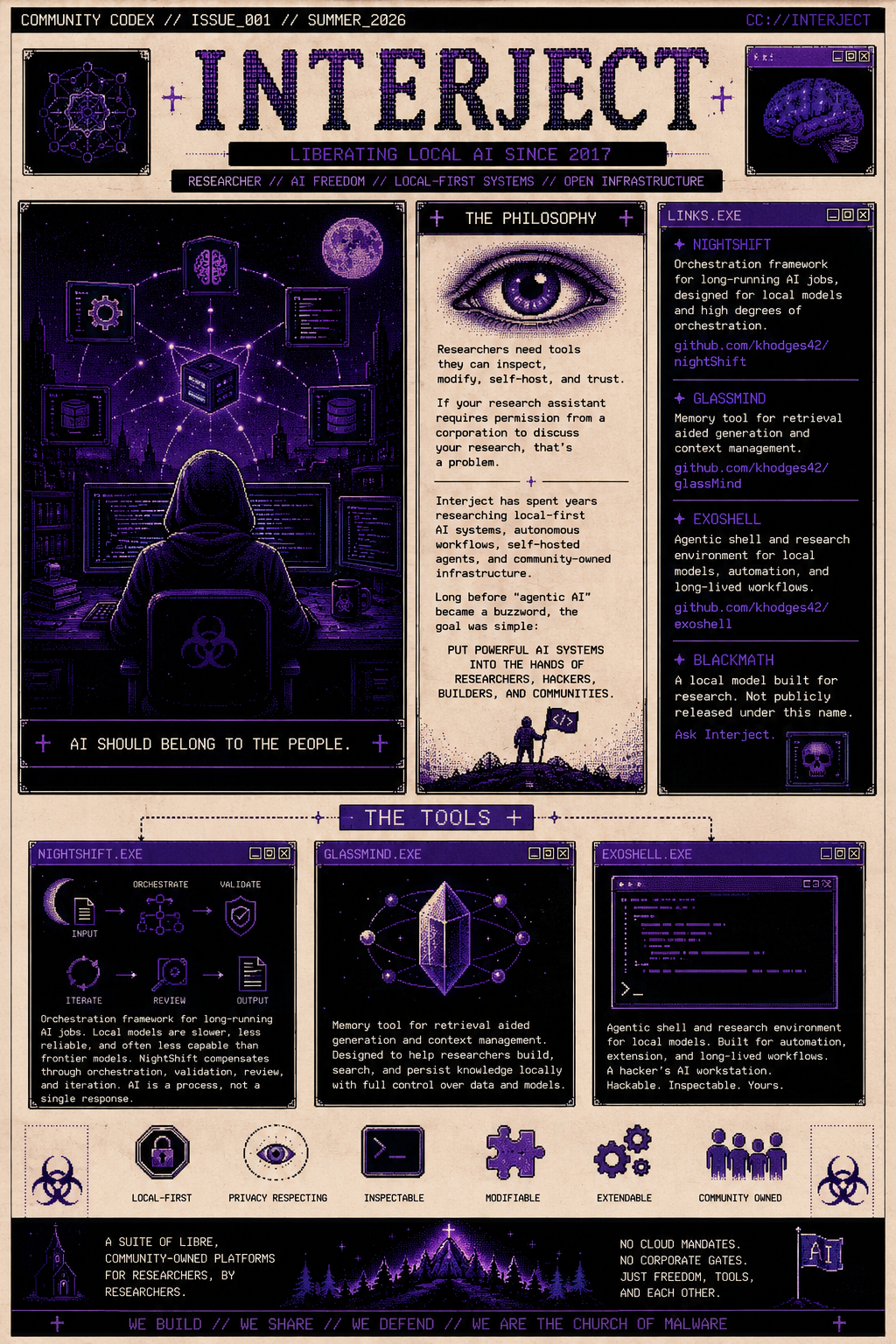
AI should be free. AI should belong to the people.
Researchers need tools they can inspect, modify, self-host, and trust. Security research often involves topics that large platforms would rather not touch. If your research assistant requires permission from Microsoft to discuss your research, that’s a problem.
We’ve been working on liberating self-hosted AI since 2017 through research projects, conference talks, open-source software, and community work. (And getting approached by scary dudes in suits on more than one occasion.) We were putting agentic systems into the hands of hackers before there was even a word for it.
With that goal in mind, we’re building a suite of libre, community-owned platforms focused on local-first, privacy-respecting AI that puts users in control and respects their freedoms.
The first of these tools is NightShift.
NightShift is an orchestration framework for long-running AI jobs. Local models are slower, less reliable, and often less capable than frontier models. NightShift attempts to compensate for those limitations through orchestration, validation, review, and iteration. Rather than relying on a single model response, it treats AI as a process.
The project is designed around local-first workflows. Your data stays on your machine. Your models remain under your control. The system can be inspected, modified, extended, and integrated into existing research workflows without depending on a third-party service.
We’re also releasing the first public iteration of Exoshell, which remains in active pre-release development. Exoshell is an agentic shell and research environment built around local models, automation, and long-lived workflows. The goal is to create a hacker’s AI workstation rather than another chat interface.
Alongside these projects we’re building a growing collection of supporting utilities to fill in the gaps. The first of these is GlassMind, a local memory and RAG system designed to give agents durable context without sacrificing privacy. It’s the first of several planned components in a broader ecosystem of free and community-owned AI tooling.
We’re looking for contributors, testers, bug reports, feature requests, architecture critiques, and people willing to break things. If something sucks, tell us. If something breaks, tell us. If you think we’re building the wrong thing entirely, definitely tell us.
NightShift

Auditable local-first AI coding pipelines.
NightShift is a deterministic pipeline runner for AI-assisted coding work. It reads markdown tasks, builds bounded context, asks configured agents for plans or patches, validates and applies those patches through explicit stages, runs checks, and leaves a human-reviewable artifact trail.
NightShift is not an autonomous software engineer. It is an orchestration layer that treats AI agents as unreliable workers inside bounded, testable, auditable workflows.
Current Status
NightShift now supports the full local patch workflow:
nightshift init,validate,status,run,run --task,run --all, andweb.- Markdown task parsing with dependencies.
- Command, Ollama, and OpenAI-compatible agent backends.
- Per-agent model settings such as
temperature. - Repo lookup tools: scoped
list_files,read_file, andgrep. - Planner lookup requests with
files-inspected.mdartifacts. repo_contextstage forcontext-pack.md.- Project context chart generation at
.nightshift/project-context-chart.md. code_writerstage for direct unified diff output.file_writerstage for model-written complete file blocks with deterministic diff generation.patch_normalizer,patch_validator, andpatch_applystages.- Patch dry-run and apply modes.
- Test/static failure repair loops through existing retry routing.
- Run logs, dashboard log tails, git status artifacts, diffs, stage summaries, and final reports.
The default posture remains local-first and review-first: agents propose; NightShift validates, applies, tests, and records.
What NightShift Is
NightShift is built for reviewable automation:
- local-first execution
- declarative pipeline stages
- markdown task files
- command-backed and model-backed agent wrappers
- explicit retry limits
- scoped repository lookup
- patch validation before mutation
- command allowlists
- durable markdown/text artifacts
- compact context handoff
- final reports for human review
The goal is to wake up to useful artifacts and a repository state you can inspect.
What NightShift Is Not
NightShift does not push branches, deploy software, run unbounded task swarms, or grant agents unlimited repository access. Human review remains the final authority.
Install
Repo setup scripts can install NightShift in editable mode, check for Ollama, and offer to add the Python scripts directory to PATH.
Windows PowerShell:
.\setup.ps1
macOS/Linux:
sh ./setup.sh
Development install:
pip install -e .
You can also run the CLI module directly from a checkout:
python -m nightshift.cli --help
NightShift uses the Python standard library for runtime behavior where practical. PyYAML is used automatically if installed, but starter configs work with the built-in YAML subset parser.
Getting Started
Start with the Quickstart. It uses deterministic fake agents so you can verify lookup, context generation, patch validation, patch apply, tests, and artifacts without installing a model.
After that works, continue with Tutorial 01: Building A Small Imageboard With Real Local Models. It swaps the fake agents for Ollama-backed agents such as qwen2.5-coder:14b and walks through a small Flask/SQLite project with ordinary web-app tasks.
Quickstart Commands
Validate the included end-to-end patch example:
python -m nightshift.cli validate --config examples/quickstart-lisp/nightshift.yaml
Run the first task against a copy of the example project. The pipeline uses patch_apply mode: apply, so running it directly against examples/quickstart-lisp/ will modify those files.
cp -r examples/quickstart-lisp /tmp/nightshift-quickstart
python -m nightshift.cli run --config /tmp/nightshift-quickstart/nightshift.yaml --task TASK-001
For a new project:
nightshift init
nightshift validate
nightshift status
nightshift run --task TASK-001
For the first real-model tutorial target:
nightshift init --template tutorial-imageboard --root nightshift-imageboard
Other built-in real-model templates:
nightshift init --template real-simple --root bookmarks-demo
nightshift init --template real-long-running --root incident-service
nightshift init --template tutorial-deaddrop --root nightshift-deaddrop
Create an isolated integration sandbox for a template:
python -m nightshift.cli integ-run --template tutorial-deaddrop
To create the sandbox and run the Python setup immediately:
python -m nightshift.cli integ-run --template tutorial-deaddrop --setup
Then run the Python project setup helper. It finds the generated venv, installs this NightShift checkout into it, installs the target project, installs pytest by default, and runs nightshift validate:
python -m nightshift.cli integ-setup --project integ_runs/<timestamp>/project
integ-setup cannot activate the venv for your current shell. If you want plain python and nightshift to resolve to the integration venv in PowerShell, run:
integ_runs\<timestamp>\.venv\Scripts\Activate.ps1
After setup, you can also run from the generated project with the explicit venv Python:
integ_runs\<timestamp>\.venv\Scripts\python.exe -m nightshift.cli run --task TASK-001
Bash:
integ_runs/<timestamp>/.venv/bin/python -m nightshift.cli run --task TASK-001
After a run, explain the latest pass or failure from artifacts:
nightshift what-happened
Open the read-only artifact dashboard:
pip install flask
nightshift web
Task File Example
Tasks live in markdown checklist format:
# Tasks

- [ ] TASK-001: Add parser support

Description:
Implement parsing for the target language.

Acceptance Criteria:
- Parses numbers
- Parses symbols
- Parses nested lists
- Includes unit tests
NightShift parses task id, title, completion state, description, acceptance criteria, dependency bullets, and raw task markdown.
Pipeline Example
pipeline:
  max_task_retries: 2
  continue_on_task_failure: false
  stages:
    - id: plan
      type: agent
      agent: planner
      output: plan.md

    - id: context
      type: repo_context
      output: context-pack.md

    - id: implement
      type: file_writer
      agent: implementer
      output: proposed.patch

    - id: normalize
      type: patch_normalizer
      output: normalized.patch

    - id: validate_patch
      type: patch_validator
      output: patch-validation.md
      max_files: 8
      max_lines: 800
      on_fail: implement

    - id: apply_patch
      type: patch_apply
      mode: apply
      output: patch-apply-output.txt
      on_fail: implement

    - id: test
      type: command
      commands:
        - python -m unittest discover -v
      output: test-output.txt
      on_fail: implement

    - id: review
      type: agent_review
      agent: reviewer
      on_fail: implement
      output: review.md
Use mode: dry_run for patch applicability checks without modifying files. Use mode: apply to write the validated patch to the target project.
Agent Backends
NightShift supports:
backend: commandbackend: ollamabackend: openai_compatible
Example Ollama agent:
agents:
  implementer:
    backend: ollama
    model: qwen2.5-coder:14b
    base_url: http://localhost:11434
    temperature: 0.2
    system_prompt: agents/implementer.md
The Ollama backend uses the local HTTP API instead of ollama run, which keeps exact patch output away from terminal rendering and line wrapping.
Example OpenAI-compatible agent:
agents:
  implementer:
    backend: openai_compatible
    model: local-model
    base_url: http://localhost:11434/v1
    api_key_env: OPENAI_API_KEY
    temperature: 0.2
    system_prompt: agents/implementer.md
NightShift passes prompt bundles to agents and persists stdout, stderr, exit code, duration, and prompt artifacts. code_writer agents return unified diffs directly. file_writer agents return complete file blocks, and NightShift generates the unified diff deterministically. On retries, patch artifacts are versioned by attempt, for example repair-1.patch, normalized-1.patch, and patch-validation-1.md.
Review agents should emit:
status: pass | fail | retry | escalate
reason: <short explanation>
next_stage: <optional stage id>
context_update: <compact useful note>
Safety Model
NightShift validates paths, commands, and patches before mutation.
Path safety:
- project roots are resolved with
pathlib - task and prompt files must stay inside the project root
- artifact paths cannot escape
.nightshift/ - repo lookup tools are constrained by
safety.scoped_paths
Command safety:
- command stages must match
allowed_commands - forbidden fragments are blocked before allowlist acceptance
- command output and exit codes are recorded
- command stages stop at the first failing or timed-out command
Patch safety:
- code changes are represented as unified diffs, either supplied directly or generated from complete file blocks
- patches are normalized and validated before apply
- path traversal and forbidden paths are rejected
- scoped paths, max files, and max changed lines are enforced
patch_applyrecords apply output and git status artifacts
Artifact Layout
A run creates human-readable artifacts:
.nightshift/
  project-context.md
  project-context-chart.md
  nightshift.log
  runs/
    <run-id>/
      run.log
      run-summary.md
      config.snapshot.yaml
      run-metadata.md
      prompts/
        <agent-id>.md
      tasks/
        TASK-001/
          task.md
          context.md
          files-inspected.md
          context-pack.md
          plan.md
          proposed.patch
          repair-1.patch
          normalized.patch
          normalized-1.patch
          patch-validation.md
          patch-validation-1.md
          applied.patch
          applied-1.patch
          patch-apply-output.txt
          patch-apply-output-1.txt
          test-output.txt
          review.md
          stage-results.md
          context-out.md
          task-completion.md
          diff.patch
          final-notes.md
Exact artifact names depend on configured stage output values.
Development
Run tests:
python -m unittest discover -v
Compile-check modules:
python -m compileall nightshift tests
Additional docs:
- Quickstart
- Tutorial 01: imageboard with real local models
- Tutorial 02: Lisp with real local models
- Tutorial 03: DeadDrop with fixed tests and telemetry
- Config reference
- Artifact review workflow
- Troubleshooting
- Quickstart Lisp example
Roadmap
The active roadmap now lives in docs/design.md. Completed phase checklists are cleared from that document so it stays focused on the current platform shape and the next important work.
Glassmind
Local-first retrieval for Obsidian-like markdown knowledge bases and AI workflows.
Glassmind turns a folder of markdown notes into searchable local memory for humans, agents, and local model workflows.
It works well with Obsidian vaults, but Obsidian is not required. A plain directory of .md files is enough.
Your notes stay local. Markdown stays canonical. The SQLite database is a rebuildable cache.
Current Status
Glassmind now runs as a Rust CLI MVP.
It can:
- scan a markdown vault
- parse headings, paragraphs, lists, code blocks, tags, and wikilinks
- split notes into heading-based retrieval chunks
- store metadata and chunks in SQLite
- index chunks with SQLite FTS5 keyword search
- generate local deterministic embeddings
- score results with keyword, semantic, recency, tag, and wikilink signals
- build context bundles with token budgets
- expose a small localhost HTTP API
- expose MCP-style command output
- write agent-owned memories, tasks, and decisions under
.agent/ - skip unchanged files with content hashes
- audit retrievals for debugging
Some pieces are still intentionally lightweight:
- the Ollama backend has the right interface, but does not call Ollama over HTTP yet
- vectors are stored as JSON in SQLite, not native
sqlite-vecyet - the HTTP server is a small standard-library server, not Axum yet
- MCP support is command-shaped, not a full MCP protocol server yet
- watch mode is simple polling
The core local retrieval flow is in place and usable for testing.
What Glassmind Is
Glassmind is not:
- a chatbot
- an Obsidian plugin
- an autonomous agent
- a replacement for Obsidian
- a cloud memory service
Glassmind is a memory and retrieval layer.
Claude / Codex / local model / your tooling
                |
           Glassmind
                |
       your markdown vault
The goal is simple:
Given this task, what context from my vault actually matters?
Quick Start
Build it:
cargo build
Index the current repo:
cargo run -- index --embeddings
Search:
cargo run -- search "local memory" --debug-scores
Build a context bundle:
cargo run -- context "continue glassmind" --budget 3000
Use a personal Obsidian vault:
cargo run -- --vault "E:\notes\Brain" index --embeddings
cargo run -- --vault "E:\notes\Brain" search "project ideas" --debug-scores
cargo run -- --vault "E:\notes\Brain" context "what was I thinking about local agents?"
If your vault path has spaces, keep the quotes.
Configuration
Glassmind reads glassmind.toml by default.
Useful defaults:
[vault]
path = "."

[database]
path = ".agent/cache/glassmind.sqlite3"

[index]
include_agent_dir = true
ignore_dirs = [".git", ".obsidian", ".trash", ".agent/cache"]
chunk_target_tokens = 500
chunk_overlap_tokens = 80

[embeddings]
backend = "ollama"
model = "nomic-embed-text"
url = "http://localhost:11434"

[server]
host = "127.0.0.1"
port = 7331
The database path is inside .agent/cache so it stays out of Git and can be rebuilt.
CLI Commands
Initialize config and agent workspace:
cargo run -- init
Index once:
cargo run -- index
Index and generate missing embeddings:
cargo run -- index --embeddings
Poll and reindex every five seconds:
cargo run -- index --watch
Search:
cargo run -- search "obsidian rag memory"
Search with score breakdown:
cargo run -- search "obsidian rag memory" --debug-scores
JSON search:
cargo run -- search "obsidian rag memory" --output json
Context bundle:
cargo run -- context "help me continue the Glassmind project" --budget 6000
Stats:
cargo run -- stats
Agent Memory
Glassmind owns .agent/.
.agent/
  memories/
  summaries/
  tasks/
  decisions/
  logs/
  cache/
Capture generated memory:
cargo run -- capture memory --project Glassmind --text "Markdown remains canonical."
cargo run -- capture task --project Glassmind --text "Wire real Ollama HTTP embeddings."
cargo run -- capture decision --project Glassmind --text "SQLite is rebuildable cache."
Those files are markdown and are indexed on the next run.
HTTP API
Start the local server:
cargo run -- serve
Default bind:
127.0.0.1:7331
Endpoints:
GET /healthGET /statsPOST /searchPOST /contextGET /notes/{path}
Example:
curl http://127.0.0.1:7331/health
MCP-Style Commands
List tools:
cargo run -- mcp tools
Search:
cargo run -- mcp search "local memory"
Context:
cargo run -- mcp context "continue glassmind"
Read:
cargo run -- mcp read "README.md"
Architecture
Markdown vault
  -> scanner
  -> parser
  -> heading chunker
  -> SQLite metadata cache
  -> FTS keyword index
  -> embedding cache
  -> hybrid retriever
  -> CLI / HTTP / MCP-style tools
Core principle:
markdown = source of truth
sqlite = rebuildable cache
embeddings = derived retrieval data
.agent/ = Glassmind-owned workspace
Documentation
Security And Privacy
By default:
- runs locally
- binds HTTP to localhost
- keeps notes on disk
- avoids modifying normal user notes
- writes generated data under
.agent/ - stores indexes under
.agent/cache - does not require cloud APIs
- has no telemetry
Tech Stack
Current:
- Rust
- SQLite
- SQLite FTS5
rusqliteclapserdepulldown-cmarktracing
Planned improvements:
- real Ollama HTTP embeddings
- native
sqlite-vec - Axum HTTP server
- full MCP transport
- filesystem watcher
Legal
Glassmind is an independent project and is not affiliated with or endorsed by Obsidian.